What adult deformity correction is
Seen from the back, a healthy spine runs fairly straight. Seen from the side, it curves gently inward at the neck and low back, and outward through the upper back. Those curves stack the head over the pelvis, so you can stand upright without working hard.
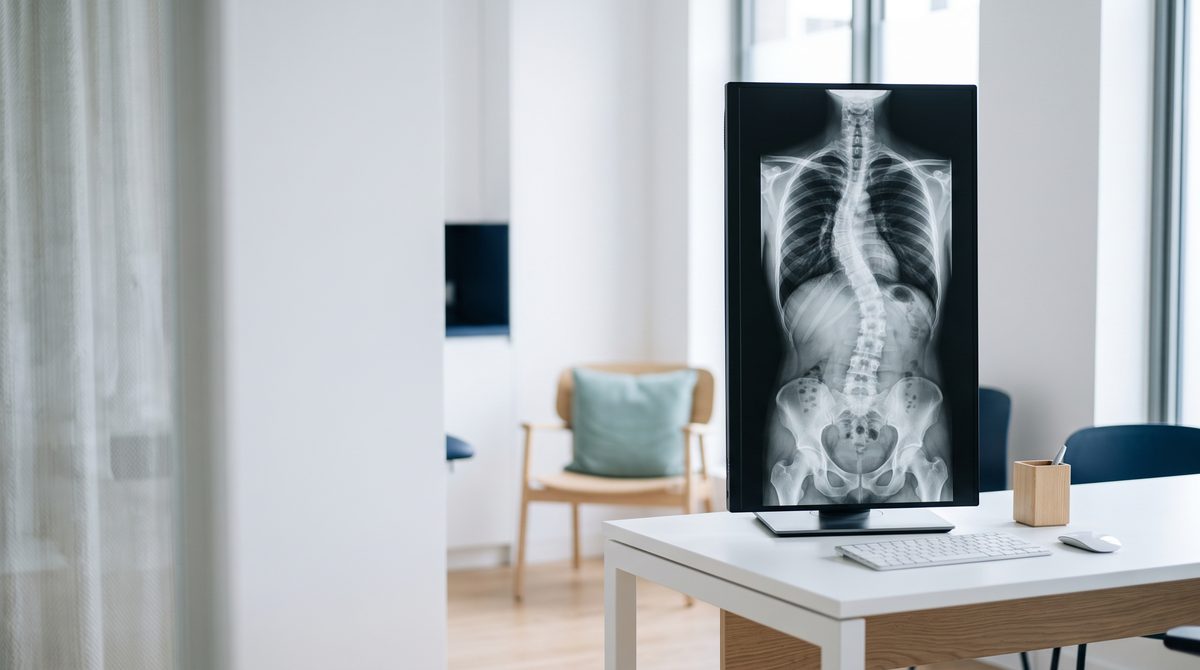
In adult spinal deformity, that shape has changed. The spine may curve to the side (scoliosis), tip forward (kyphosis), lose the inward curve of the low back (flatback), or have one vertebra slipped forward on another (spondylolisthesis). Many adults have a combination. When the spine tips forward, the body tries to make up for it by tucking the pelvis and bending the knees. That takes effort, and it is one reason people with deformity often feel tired and sore after standing or walking for a short time.
Correction surgery has three main goals: take pressure off pinched nerves, restore better alignment and balance, and hold that position with a solid fusion. It usually involves screws and rods across several vertebrae. Some cases also need reshaping of the bone, called an osteotomy, or spacers placed in the disc spaces to restore height and curve.
Who may be a candidate
Most adults with a spinal curve do not need surgery. Physical therapy, activity changes, pain medicine and injections help many people. Surgery is usually discussed when:
- Back or leg pain limits daily life despite good nonsurgical care
- You lean forward or to the side and cannot stand upright for long
- Leg pain, numbness or weakness comes from nerves pinched by the curve, often with narrowing of the spinal canal
- The curve is getting worse on x-rays taken over time
- A fusion from an earlier surgery has left the spine out of balance, sometimes called flatback
General health matters a great deal for an operation this size. Heart and lung health, diabetes, bone density, nutrition, nicotine use and your goals are all part of deciding whether surgery is a good choice. For some people, a smaller operation that only frees the nerves is the better plan. For others, not having surgery is the right call. You can read more background in adult scoliosis explained.
Planning comes first
Planning for deformity surgery usually takes more time than planning for other spine operations. It commonly includes:
- Standing full-spine x-rays from the front and side, showing how your head, spine and pelvis line up when you stand
- Bending or flexibility x-rays to see how much of the curve is stiff and how much is flexible
- MRI or CT scans to see the nerves and the shape of the bone
- A bone density test, since screws need good bone to hold. Some patients are started on a bone-building medicine before surgery
- Medical clearance from your primary care doctor and, when needed, a heart or lung specialist
- Nutrition and lifestyle steps, such as stopping nicotine and getting blood sugar and vitamin D in a good range
From the x-rays, the surgeon measures angles that describe your balance, including how the curve of your low back matches the shape of your pelvis. These numbers guide how much correction is planned at each level.
How the surgery works
Access
Depending on the plan, the spine is reached from the back, the side, the front, or a combination.
Free the nerves
Bone, ligament or disc that is pinching nerves is removed, and discs may be cleared to make room for spacers.
Correct the shape
Spacers, osteotomies and shaped rods are used to bring the spine toward the planned alignment.
Fuse
Screws and rods hold the correction while bone graft helps the vertebrae heal together into a solid section.
Screws are often placed with image-guided navigation. Nerve monitoring is commonly used during the case to watch how the spinal cord and nerves are working. Larger corrections are sometimes split into two operations a few days apart. The operation can take many hours, and blood loss is higher than with smaller spine surgery. A blood transfusion is sometimes needed.
Recovery: what it tends to look like
Recovery from deformity correction is measured in months, not weeks. These ranges are common, not guaranteed:
- Hospital. Surgery and the first days of recovery are at Fresno Surgical Hospital, often several days to a week or more. Some patients go to an inpatient rehab unit before going home.
- First weeks. Walking starts early with help from therapists. Many people use a walker at first. Help at home with meals, bathing and driving is usually needed.
- First three months. Limits on bending, lifting and twisting are common. Energy returns slowly.
- Fusion. The bones take many months to fuse. Full recovery often takes a year or longer.
- Follow-up. Standing x-rays at visits check the hardware, the fusion and your alignment over time.
Some people notice they stand taller and straighter right after surgery. Pain and walking distance tend to change more gradually. How much improvement a person gets varies, and some symptoms may remain.
Risks
The risks of deformity correction are higher than for smaller spine operations, and they deserve a full, honest talk. They include:
- Infection, bleeding and the need for a blood transfusion
- Nerve or spinal cord injury, including weakness or numbness
- Blood clots in the legs or lungs
- Heart, lung or other medical problems around the time of surgery
- The bones not fusing, or rods breaking or screws loosening
- Breakdown just above the top of the fusion, called proximal junctional kyphosis
- Wear at levels next to the fusion over time
- The need for more surgery, which is more common after large fusions
We will go through each risk as it applies to your health, age and the size of the planned operation.
Dr. Higginbotham and deformity surgery
Scoliosis correction and spinal deformity correction were among the areas of expertise listed for Dr. Higginbotham when he began practice in Fresno. He completed his orthopaedic spine fellowship at UC Davis, where his research included a study of front versus back fusion for adults with isthmic spondylolisthesis (JAAOS, 2026). In 2026 he performed his first lateral lumbar fusion done with the patient lying face down, using an expandable spacer and screws aimed at restoring the inward curve of the low back and realigning the level.
He is also first author of a national survey on how spine surgeons check nutrition, function and bone health before surgery (JAAOS, 2024). That kind of preparation matters most in large operations like deformity correction.
Questions to ask at your visit
- Is my pain coming from the curve itself, from pinched nerves, or both?
- Would a smaller operation that only frees the nerves be reasonable for me?
- How many levels would be fused, and would it reach my pelvis?
- Will the surgery be done in one stage or two?
- What should I do about my bone density, nutrition or other health issues before surgery?
- What help will I need at home, and for how long?
Since this is a big decision, many patients choose to get a second opinion. We welcome that.
Frequently asked questions
Can adult scoliosis be fully straightened?
Usually the aim is better balance and less nerve pressure, not a perfectly straight spine. Stiff curves in adults often cannot be fully corrected safely, and full correction is not always needed for good balance.
Am I too old for deformity surgery?
Age alone does not decide it. Overall health, bone quality, how much the deformity limits you and your goals matter more. Some older adults are good candidates and some are not.
Will I lose flexibility after a long fusion?
The fused section will not bend. Many people adapt by bending at the hips and knees. A fusion that reaches the pelvis limits some motions, like reaching down to tie shoes, and tools such as a sock aid can help.
Will I be taller after surgery?
Some patients stand taller once a curve or forward lean is corrected. The amount varies and is not the main goal.
Do I need to wear a brace afterward?
Some surgeons use a brace for comfort or extra support for a period after surgery, and some do not. It depends on the operation and your bone quality.
How soon should I decide?
Unless there are signs of serious nerve damage, deformity surgery is rarely urgent. Taking time to prepare your health and ask questions is often wise.