
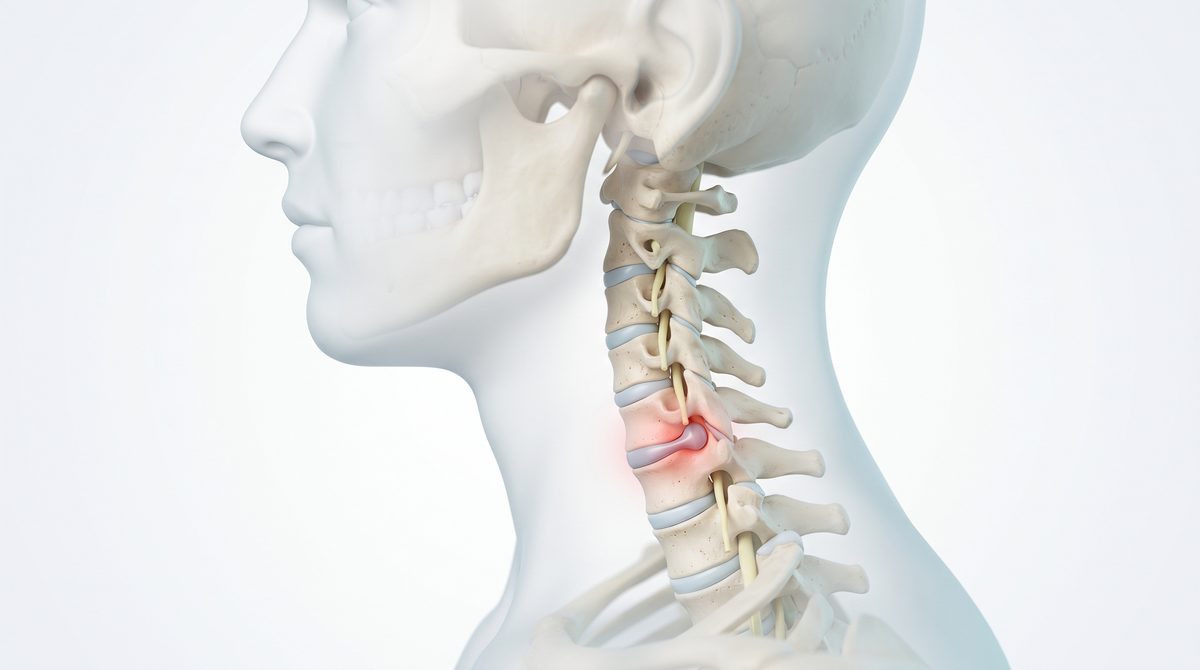
What a cervical disc herniation is
In the neck, a disc sits between each pair of vertebrae below the second bone. Each disc has a firm outer ring, the annulus, and a gel-like center, the nucleus. With age, strain or sometimes an injury, the ring can weaken or tear. Part of the center then bulges or breaks through. When that material moves backward, it can press on the nerve root leaving the spine at that level, or on the spinal cord itself.
Pressure on a nerve root is called cervical radiculopathy, often described as a pinched nerve in the neck. Pressure on the spinal cord is called myelopathy. The two can happen together. Most herniations happen at the lower neck levels, between the fifth and sixth or the sixth and seventh vertebrae, since those levels move the most.
Symptoms
Symptoms depend on which nerve is involved. Common signs of a pinched nerve root include:
- Neck pain, often with pain along the shoulder blade
- Sharp, burning or aching pain that runs down one arm
- Numbness or tingling in part of the hand, such as the thumb and index finger, or the ring and little fingers
- Weakness when lifting the arm, bending the elbow, gripping or straightening the wrist
- Relief when resting the hand on top of the head, which takes tension off the nerve
Signs that the spinal cord may be under pressure are different and need prompt attention:
- Clumsy hands, trouble with buttons, writing or picking up small objects
- A change in balance or walking, or a feeling of stiffness in the legs
- Numbness in both hands
Go to an emergency room or call 911 for sudden weakness in the arms or legs, trouble walking that is getting worse, or new loss of bladder or bowel control.
How it is diagnosed
Your story
Where the pain travels, which fingers are numb and what positions help are strong clues to the level involved.
Nerve exam
Strength in each muscle group, reflexes, sensation and tests that gently load the nerve help confirm which root is pinched.
Imaging
X-rays show alignment and motion. An MRI shows whether the disc is touching a nerve root or the cord.
Extra tests
Nerve conduction studies are sometimes used to rule out a nerve problem in the arm, like carpal tunnel syndrome.
Shoulder problems can also cause pain near the shoulder blade and upper arm. Part of the exam is sorting out whether the neck, the shoulder or both are involved.
Treatment without surgery
Many people with a pinched nerve in the neck get better without surgery over several weeks to a few months. The body can shrink or reabsorb part of a herniated disc over time. Nonsurgical care often includes:
- Short-term rest from heavy lifting and overhead work, while staying generally active
- Anti-inflammatory medicine, nerve pain medicine or a short course of steroid pills, when safe for you
- Physical therapy for posture, neck and shoulder blade strength and nerve gliding
- A cervical epidural steroid injection for arm pain that is severe or slow to improve
Our guide to nonsurgical spine care explains these steps, and when to see a spine surgeon covers the signs that it is time for a surgical opinion.
When surgery may help
Surgery may be considered when arm pain stays severe after good nonsurgical care, when weakness is significant or getting worse, or when the spinal cord is being compressed. The goal is to remove the disc material or bone spur that is pressing on the nerve. Options include:
- Cervical disc replacement, which removes the disc from the front of the neck and places an artificial disc designed to keep motion
- Anterior cervical discectomy and fusion (ACDF), which removes the disc from the front and joins the two vertebrae
- Posterior cervical foraminotomy, which widens the nerve's exit opening from the back of the neck. In selected cases this can be done with an endoscope through a small opening
The right choice depends on where the fragment sits, how many levels are involved, the health of the joints at the back of the neck and whether the spinal cord is affected. Read disc replacement versus ACDF for a closer comparison. Every operation has risks, including trouble swallowing after front-of-neck surgery, infection and nerve injury. Arm pain often improves sooner than numbness or weakness.
Dr. Higginbotham's experience
Disc herniation treatment and cervical disc replacement are both among Dr. Higginbotham's listed areas of expertise. In early 2026 he performed a cervical total disc replacement at Saint Agnes Medical Center for a patient with neck and shoulder pain and pain and numbness running down the arm. He has also described endoscopic surgery as a way to treat herniated discs "through tiny incisions." He completed his spine fellowship at UC Davis.
Questions to ask at your visit
- Which nerve root is pinched, and does my MRI match my symptoms?
- Is there any pressure on my spinal cord?
- How long is it reasonable to try nonsurgical care?
- Would I be a candidate for disc replacement, fusion or a posterior approach?
- What symptoms should make me call right away?
Frequently asked questions
Can a herniated disc in the neck heal on its own?
Often, yes. Many people improve over weeks to months as inflammation settles and the body reabsorbs part of the herniation. Follow-up is still important if you have weakness.
Why does my arm hurt more than my neck?
The nerve root that is pinched in the neck carries feeling and strength to the arm. Irritation of that nerve is felt along its path, so arm pain can be worse than neck pain.
Is it safe to get a chiropractic adjustment with a herniated disc?
Ask your spine doctor first, especially if you have weakness or signs of spinal cord pressure. Fast, forceful neck manipulation is usually avoided in those situations.
How long should I try therapy before thinking about surgery?
For arm pain without major weakness, many doctors suggest about six weeks or more of good nonsurgical care. Weakness that is getting worse or spinal cord pressure may call for an earlier surgical opinion.
Should I sleep with a special pillow?
A pillow that keeps your neck in a neutral position, not bent far forward or tipped back, is often more comfortable. Some people sleep better with the painful arm resting on a pillow.
Will I need a neck brace?
Braces are not usually needed for a herniated disc treated without surgery. After surgery, some patients use a soft collar for comfort for a short time.