
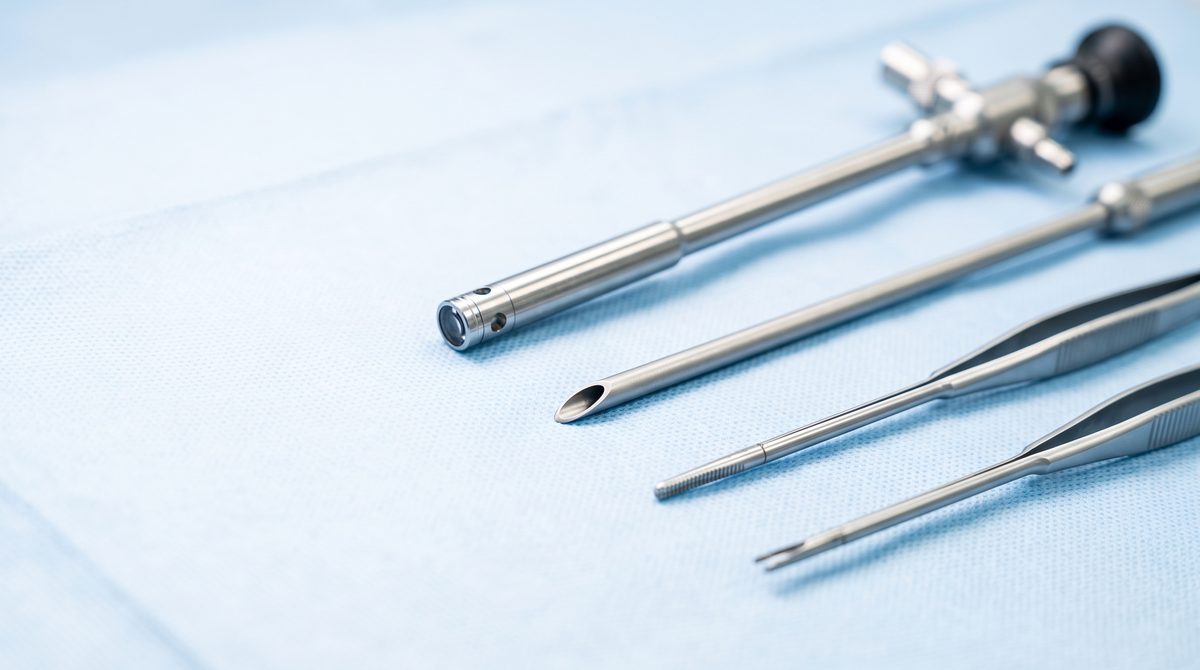
What endoscopic spine surgery is
An endoscope is a thin camera with its own light. In endoscopic spine surgery, the surgeon places a tube, usually less than half an inch wide, through a small cut in the skin and guides it to the spot where a nerve is being pressed. The camera sends a magnified, high-definition picture to a screen in the operating room. Small instruments go down a channel inside the same scope to remove the material that is pinching the nerve.
That material is most often a piece of herniated disc. It can also be a thickened ligament or a bone spur that is crowding the opening where a nerve leaves the spine. Saline, a salt-water solution, flows through the scope during the operation. It keeps the view clear and rinses the area.
There are two main ways to reach the spine with an endoscope:
- Transforaminal. The tube comes in from the side, through the natural opening (the foramen) where the nerve exits. This path is often used for discs that have pushed out toward the side.
- Interlaminar. The tube comes in from the back, through the gap between two vertebrae. This path is often used at the lowest levels of the spine and for some types of central narrowing.
Some surgeons also use a two-portal method, with one small opening for the camera and a second one for the tools. The right path depends on where the problem sits, your anatomy and what the imaging shows.
How it compares with a microdiscectomy
For a herniated disc in the low back, the long-standing operation is a microdiscectomy. It uses a microscope and an incision of about an inch or so, with the muscle gently pulled to one side. It has a long track record and remains a very good operation.
The endoscopic approach aims at the same goal with less disruption of the muscle and soft tissue. For some people this may mean less pain in the first days and an easier return to walking. It is not a better operation for every problem, and it takes specific training and equipment. Dr. Higginbotham will explain which approach he recommends for your spine and why, including when the standard open approach is the safer choice.
Who may be a candidate
Endoscopic surgery is usually considered for problems that press on one or two nerves in a limited area. Common examples include:
- A herniated disc in the lumbar spine that sends pain down the leg, often called sciatica from a pinched nerve root
- Foraminal or lateral recess narrowing, which are forms of lumbar spinal stenosis where the nerve gets squeezed on its way out
- In selected cases, a herniated disc in the neck that presses on a nerve root from the side and can be reached from the back of the neck
- A disc that herniates again after an earlier discectomy, in some patients
It is usually not the right tool when the spine is unstable, when one vertebra has slipped forward on another and is moving, when there is a large curve, or when many levels need treatment. Those problems often need a fusion or a larger reconstruction. Surgery is also usually not the first step. Most people with a pinched nerve try time, activity changes, physical therapy and, for some, an injection before surgery is discussed.
Signs that a surgical opinion may be worth getting include leg or arm pain that stays severe after several weeks of good nonsurgical care, weakness in the foot or hand, or pain that keeps you from working, sleeping or walking.
How the surgery works, step by step
Planning
Your MRI and exam are matched to your symptoms so the target level and side are clear before surgery day.
Positioning and x-ray
You lie face down. Live x-ray guides a thin needle and then the tube to the exact spot next to the nerve.
Removing the pressure
Through the scope, the surgeon removes the disc fragment, ligament or bone spur and checks that the nerve moves freely.
Closing
The tube comes out and the small cut is closed, often with one or two stitches and a bandage.
Depending on the level and approach, the operation may be done under general anesthesia or under sedation with numbing medicine. Your anesthesia team will talk with you about which is planned. Many endoscopic procedures take about one to two hours, though some take longer.
Recovery: what it tends to look like
Every recovery is different. The ranges below are common patterns, not promises.
- Going home. Dr. Higginbotham does these procedures at Fresno Surgical Hospital, and many patients go home the same day. Some stay one night, based on their health, pain control or the time the surgery ends.
- Walking. You will usually be encouraged to walk the day of surgery or the next day. Short, frequent walks help.
- The first two weeks. Soreness at the incision is common. Leg pain from the nerve may ease quickly for some people and more slowly for others. Some people feel burning or tingling in the leg for a few weeks while the nerve settles.
- Work and driving. People with desk jobs often return within one to three weeks. Physical jobs usually take longer, often six weeks or more, with lifting limits in the meantime. You should not drive while taking opioid pain medicine.
- Physical therapy. Some patients start a guided therapy program a few weeks after surgery to build core and leg strength.
Numbness or weakness that was present before surgery may improve over weeks to months, may improve only partly, or may not change. How long the nerve was pinched and how hard it was pressed both play a part.
Risks
A small incision does not make an operation risk-free. The risks of endoscopic spine surgery include:
- Infection or bleeding
- A tear in the thin lining around the nerves (a dural tear), which can cause a leak of spinal fluid
- Nerve irritation or injury, including temporary burning pain or numbness in the leg
- Pain that does not improve, or relief that is only partial
- The disc herniating again at the same level, which can happen after any discectomy
- The need to change to a larger open approach during surgery
- Risks from anesthesia, and blood clots
We will go over how each risk applies to your health and your spine before you decide.
Dr. Higginbotham and endoscopic spine surgery
Dr. Devan Higginbotham is a fellowship-trained orthopaedic spine surgeon who completed his spine fellowship at UC Davis. In 2025 he performed what was reported as the first endoscopic spine surgery in Fresno. In his words, the technique "allows us to treat conditions like herniated discs through tiny incisions."
His research includes a co-authored review of nerve narrowing in the low back (Spartan Medical Research Journal, 2023) and a study of professional athletes after lumbar discectomy or microdiscectomy (Spartan Medical Research Journal, 2022). He also treats patients without surgery when that is the better fit.
Questions to ask at your visit
- Which nerve is pinched, and does my MRI match my symptoms?
- Can an endoscope reach the problem, or would a microdiscectomy or another operation be better for me?
- Will I have general anesthesia or sedation?
- What would you expect for my leg pain, and for any numbness or weakness I have now?
- How soon can I return to my kind of work?
- What happens if the disc herniates again?
For a checklist to bring along, see how to prepare for spine surgery. If you want to understand the approach in general first, read what minimally invasive spine surgery means.
Frequently asked questions
Is endoscopic spine surgery the same as laser spine surgery?
No. Endoscopic surgery uses a camera and small instruments to remove the disc or bone pressing on the nerve. Some endoscopic tools use radiofrequency energy to control bleeding, but the work is done with instruments, not a laser.
How big is the scar?
The skin opening is usually under an inch, often closer to a third of an inch. Most people end up with a small line or dot that fades over time.
Will I be awake during the operation?
That depends on the level and the approach. Some endoscopic procedures are done under general anesthesia, and some are done with sedation and numbing medicine. The plan is decided with you and the anesthesia team before surgery.
Can the disc herniate again after endoscopic surgery?
Yes. A disc can herniate again after any discectomy, open or endoscopic. The risk is usually highest in the first months. Following lifting limits early on may help, and a repeat herniation can often be treated.
Does it work for spinal stenosis?
For some types. Narrowing where the nerve exits, or in the side channel of the spinal canal, can often be reached with an endoscope. Stenosis at many levels, or stenosis with a slipped and moving vertebra, may need a different operation.
Do I need a referral?
Some insurance plans require one and some do not. Call our office and we can tell you what your plan needs before your first visit.