
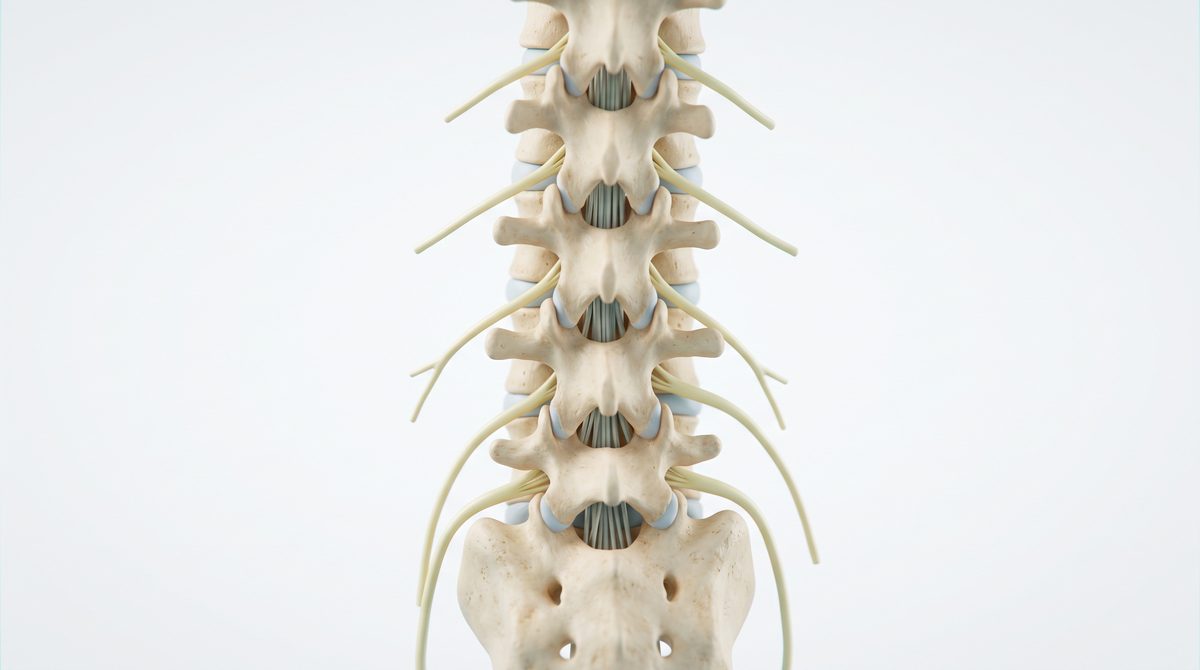
What lumbar stenosis is
The spinal nerves travel down a bony tunnel called the spinal canal. At each level, a pair of nerve roots leaves the canal through side openings called foramina. Lumbar stenosis means one or more of these spaces in the low back has become too tight for the nerves inside.
The narrowing is usually a slow, age-related process. Discs lose height and bulge backward. The ligament along the back of the canal, called the ligamentum flavum, thickens and folds inward. The small facet joints grow arthritis and bone spurs. In some people, one vertebra slips forward on the one below, a condition called degenerative spondylolisthesis, which narrows the canal further. A smaller number of people are born with a narrow canal and develop symptoms earlier in life.
Doctors describe stenosis by where it sits:
- Central stenosis narrows the middle of the canal and can affect nerves to both legs.
- Lateral recess stenosis narrows the gutter on one side of the canal, just before the nerve turns to exit.
- Foraminal stenosis narrows the exit opening itself and usually affects one nerve on one side.
Symptoms
The classic pattern is called neurogenic claudication. It means leg symptoms that come on with standing or walking and go away with sitting or bending forward. Bending forward opens the canal a little, which is why many people with stenosis feel better leaning on a shopping cart or walking uphill.
- Aching, cramping, heaviness or tiredness in the buttocks, thighs or calves when you walk or stand
- Numbness or tingling in the legs or feet
- Needing to sit down after a set distance, and being able to go again after a short rest
- Low back pain, often less bothersome than the leg symptoms
- In more advanced cases, leg weakness or a feeling that your balance is off
Pain from poor blood flow in the legs can look similar. With blood flow problems, pain usually eases when you stop and stand still, even without sitting. Riding a stationary bike, which keeps you bent forward, is often easier with stenosis. A careful exam, including checking the pulses in your feet, helps tell the two apart.
Seek emergency care for new trouble controlling your bladder or bowels, numbness in the groin or inner thighs, or leg weakness that is getting worse quickly. Call 911 or go to the nearest emergency room.
How it is diagnosed
History
How far you can walk, what makes it better and which leg is worse all point to the level and type of narrowing.
Exam
Strength, reflexes, sensation and foot pulses are checked to look for nerve involvement and rule out blood flow problems.
X-rays
Standing and bending x-rays show alignment and whether a vertebra slips or moves too much.
MRI
MRI shows the nerves and where they are squeezed. A CT with dye may be used if you cannot have an MRI.
Stenosis on an MRI is very common in older adults, including many who feel fine. The key step is matching what the images show to your actual symptoms and exam. Our article on common MRI report terms explains words like "foraminal narrowing" and "facet hypertrophy."
Treatment without surgery
Many people with lumbar stenosis manage well for years without an operation. For some, symptoms stay about the same over time. Nonsurgical care often includes:
- Physical therapy focused on core strength, hip flexibility and positions that open the canal
- A walking or stationary bike program, building distance gradually
- Anti-inflammatory or nerve pain medicine for a period, when safe for you
- Epidural steroid injections, which may calm leg pain for weeks to months in some people
- Weight management and staying active, which lower the load on the low back
See nonsurgical options for back pain for more on each of these.
When surgery may help
Surgery is usually considered when leg symptoms limit how far you can walk or stand, when good nonsurgical care has not been enough, or when there is weakness that is getting worse. The main goal is to relieve leg symptoms by giving the nerves more room. Surgery tends to help leg pain more than back pain.
- Decompression (laminectomy or laminotomy). The surgeon removes the bone, thickened ligament and spurs pressing on the nerves. This is the most common operation for stenosis.
- Endoscopic decompression. For some patterns, especially lateral recess and foraminal narrowing, the same work can be done through a small tube with endoscopic spine surgery.
- Decompression with fusion. When a vertebra has slipped and moves too much, the spine may need to be stabilized. Screws are often placed using navigation with 3D imaging.
- Deformity correction. When stenosis comes with a larger curve or loss of balance, spinal reconstruction may be discussed.
Every operation has risks, including infection, bleeding, a tear in the lining around the nerves, nerve injury and the chance of symptoms returning in later years. Many people get meaningful relief, but results vary and are not guaranteed.
Dr. Higginbotham's work with stenosis
Spinal decompression is one of the procedures Dr. Higginbotham has listed among his areas of expertise since starting practice in Fresno. He co-authored a scoping review of foraminal stenosis in the lower spine that covered its causes, symptoms, imaging and treatment (Spartan Medical Research Journal, 2023). He also co-authored a report on stenosis in the mid back caused by a calcified ligamentum flavum (Ochsner Journal, 2023).
Questions to ask at your visit
- Is my stenosis central, lateral recess, foraminal or a mix?
- Is any vertebra slipping or moving too much?
- Are my leg symptoms from my spine, from blood flow, or both?
- Which nonsurgical treatments make sense to try first?
- If I need surgery, would I need a fusion, or only a decompression?
Frequently asked questions
Will lumbar stenosis get worse over time?
Not always. Many people have stable symptoms for years. Some slowly get worse, and a smaller number improve. Regular follow-up helps track changes in walking distance and strength.
Why can I walk farther when I lean on a shopping cart?
Leaning forward opens the spinal canal a little and takes some pressure off the nerves. That is a common sign of lumbar stenosis.
Is walking bad for stenosis?
No. Walking is usually encouraged, in amounts you can manage, with rest breaks. A stationary bike or walking in a pool can be easier ways to stay active.
Do epidural injections fix stenosis?
Injections do not widen the canal. They may reduce inflammation around the nerves and ease leg pain for a time, which can make therapy and walking easier.
Can stenosis cause weakness in my legs?
Yes, in more advanced cases. New or worsening weakness, like a foot that drags, should be checked by a spine specialist soon.
Do I need a fusion if I have stenosis?
Most people with stenosis who need surgery do well with a decompression alone. A fusion is added when the spine is unstable or a vertebra has slipped and moves.