
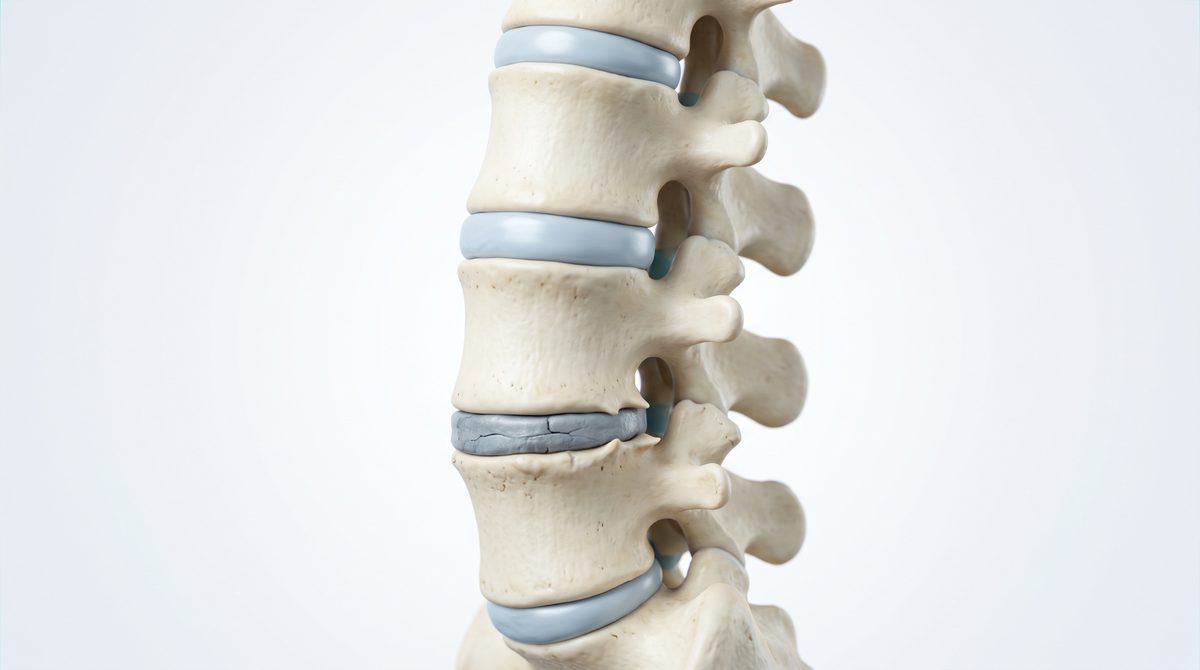
What degenerative disc disease is
Discs are the cushions between the vertebrae. Each has a strong outer ring and a soft, water-rich center. Starting in early adulthood, discs slowly lose water. They get thinner and stiffer, and small cracks can form in the outer ring. This process is called disc degeneration. The name "degenerative disc disease" makes it sound worse than it usually is. It is less a disease and more a description of what the disc looks like.
Disc wear is very common. Studies of people with no back pain at all find worn, bulging or darker discs on MRI in a large share of adults, and the share rises with age. Genes, past injuries, heavy physical work, smoking and body weight all play a part in how fast discs wear.
Degeneration becomes a clinical problem in two main ways:
- Pain from the disc itself. A worn disc and the joints around it can be a source of ongoing neck or back pain, sometimes called discogenic pain.
- Pressure on nerves. As the disc thins and bulges, and bone spurs form around it, the openings for the nerves can narrow. That can lead to a pinched nerve in the neck, leg pain from a pinched low back nerve or spinal stenosis.
Over time, disc wear can also lead to slipping of one vertebra on another, or to a curve in the spine. These are covered on our page about adult spinal deformity.
Symptoms
Symptoms depend on where the worn disc is and whether nerves are involved.
- In the low back: aching pain in the low back or buttocks that often gets worse with sitting, bending or lifting and eases with walking or changing position. Pain may flare for days or weeks and then settle.
- In the neck: neck pain and stiffness, sometimes with headaches at the base of the skull or pain near the shoulder blades.
- With nerve pressure: pain, numbness or tingling that runs into an arm or leg, or weakness in the hand or foot.
Pain that wakes you at night, or comes with fever, weight loss you cannot explain, a history of cancer, or new trouble with bladder or bowel control, is not typical of disc wear and should be checked promptly.
How it is diagnosed
Because disc wear shows up on so many scans, the diagnosis is not made from an MRI alone. The work is in linking the images to your symptoms.
History
What positions and activities make the pain better or worse, and whether it travels into a limb.
Exam
Motion, tenderness, strength, reflexes and sensation, to see whether nerves are involved.
X-rays
Standing and bending views show disc height, bone spurs, alignment and any abnormal motion.
MRI
Shows disc water content, tears in the outer ring, bulges and whether nerves are pressed.
MRI reports use terms like "desiccation," "annular fissure" and "Modic changes." Our guide to what your MRI report means explains them in plain language.
Treatment without surgery
Most people with painful disc degeneration improve with nonsurgical care, and flare-ups often settle within weeks. Common steps include:
- Staying active, with walking and gradual return to normal activity rather than bed rest
- Physical therapy that builds core, hip and neck strength and improves how you move and lift
- Anti-inflammatory medicine for flare-ups, when safe for you
- Weight management and quitting nicotine, both of which lower strain on the discs
- Injections in selected cases, most often when a nerve is irritated
Read more in nonsurgical care for back and neck pain.
When surgery may help
Surgery is most helpful when a worn disc is pressing on a nerve or the spinal cord, or when the spine has become unstable. Options depend on the location:
- In the neck: cervical disc replacement, which removes the disc and keeps motion, or an anterior cervical fusion
- In the low back, with a pinched nerve: a decompression, which in some cases can be done with endoscopic surgery through a small tube
- In the low back, with instability or slipping: a fusion, often with screws placed using 3D navigation
Surgery for back pain alone, without nerve pressure or instability, is a harder question. Results are less predictable, and it is considered only after a long course of nonsurgical care and a careful review. We will give you a straight answer about whether we think surgery is likely to help you.
Dr. Higginbotham's research on disc and fusion care
Cervical disc replacement and cervical and lumbar fusion are among Dr. Higginbotham's listed areas of expertise. He co-authored a systematic review of a bone graft material used in lumbar fusion (Global Spine Journal, 2024) and was first author of a national survey on nutrition and bone health optimization before spine surgery (JAAOS, 2024). He also co-authored a study of low back pain videos on TikTok as a source of patient education (JAAOS Global Research and Reviews, 2024).
Questions to ask at your visit
- Which disc, if any, do you think is causing my pain?
- Are any nerves being pressed?
- Is my spine stable, or is a vertebra moving too much?
- What exercises should I do, and which should I avoid?
- What would change your recommendation about surgery?
Frequently asked questions
Does degenerative disc disease always get worse?
Disc wear usually continues slowly with age, but pain does not always follow the same path. Many people have less pain as the years go on, even as their discs continue to change.
Can a worn disc grow back or heal?
A disc does not regrow its lost water and height. Strength, movement and pain can still improve a great deal with the right care.
Should I stop exercising?
No. Staying active is one of the most helpful things for disc-related pain. Therapy can help you find activities that load the spine safely.
My MRI says I have disc degeneration at several levels. Is that bad?
Not necessarily. Changes at several levels are common with age and often cause no pain. What matters is whether the findings match your symptoms.
Is disc replacement an option for the low back?
Lumbar disc replacement exists but fits a narrow group of patients. It is not one of the focus procedures at our practice. We can talk about whether it has any role for you and where it is done.