
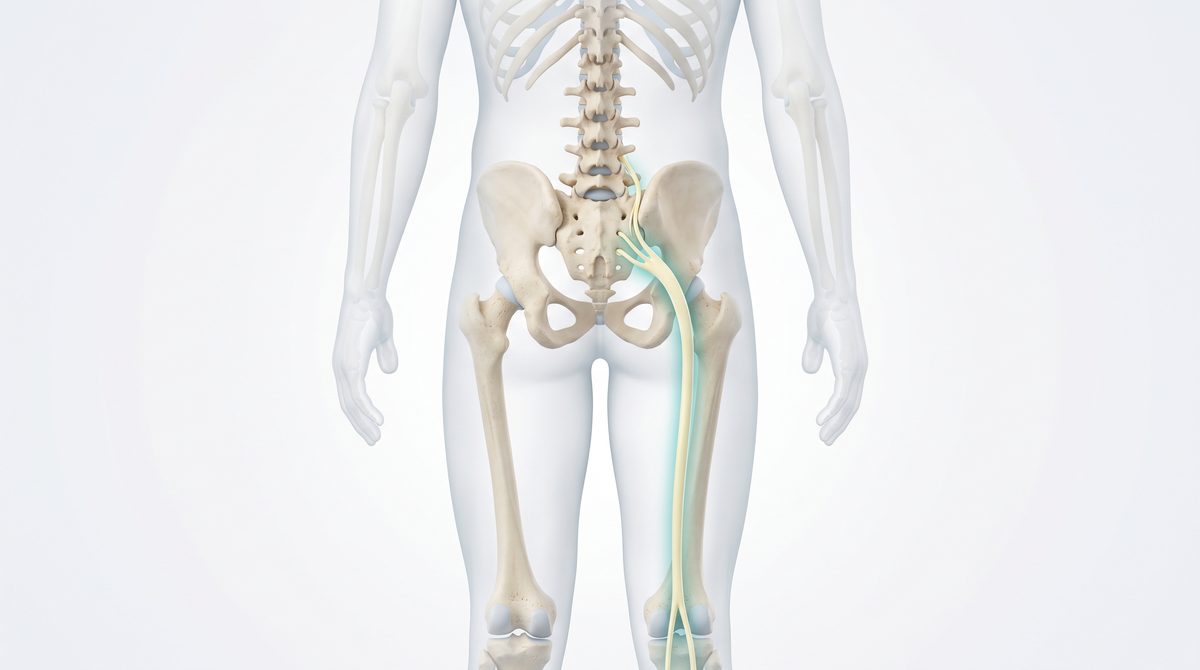
What sciatica is
Sciatica is a description of symptoms, not a diagnosis on its own. The sciatic nerve is the largest nerve in the body. It forms from nerve roots that leave the lower spine, joins together in the buttock and runs down the back of the thigh to the leg and foot. When one of those nerve roots is pressed or inflamed, pain can be felt anywhere along that path. Doctors call this lumbar radiculopathy.
The most common cause is a herniated disc in the low back, usually at one of the two lowest levels. Other causes include:
- Stenosis in the low back, where bone spurs and thickened ligament narrow the nerve's path
- Spondylolisthesis, where one vertebra slips forward and narrows the opening for the nerve
- Disc wear with bone spurs near the nerve's exit
- Less often, irritation of the nerve in the buttock, or rare causes such as a cyst, infection or tumor
Symptoms
- Sharp, burning or electric pain running from the buttock down the back or side of one leg, often below the knee
- Numbness or tingling in the leg or foot
- Weakness, such as trouble lifting the front of the foot or pushing off with the toes
- Leg pain that is worse than back pain
- Pain that gets worse with sitting, coughing, sneezing or bending forward
The location of the symptoms often points to the nerve root. Pain and numbness on the top of the foot and big toe often suggest the fifth lumbar nerve. Pain in the calf, the outer edge of the foot and the sole often suggests the first sacral nerve. Our article sciatica vs. back pain explains how nerve pain differs from ordinary back strain.
This is an emergency: new loss of bladder or bowel control, numbness in the groin, genitals or inner thighs, or weakness in one or both legs that is quickly getting worse. These can be signs of cauda equina syndrome. Call 911 or go to the nearest emergency room right away.
How it is diagnosed
Talk it through
How the pain started, where it travels and what eases it help narrow down the cause.
Nerve exam
Strength, reflexes, sensation and a straight-leg raise test show which nerve is involved.
Wait or image
Without warning signs, imaging is often not needed in the first weeks. X-rays may check alignment.
MRI when needed
An MRI is used when pain lasts beyond several weeks, when there is weakness, or when a procedure is being considered.
Treatment without surgery
The outlook for sciatica is often good. Many people improve a great deal within six to twelve weeks, and a herniated disc can shrink over time as the body reabsorbs it. Care in that period aims to control pain and keep you moving:
- Staying as active as the pain allows, with short walks and position changes, rather than bed rest
- Anti-inflammatory medicine, nerve pain medicine or a short course of steroids, when safe for you
- Physical therapy for core strength, flexibility and nerve mobility
- An epidural steroid injection, which may ease severe leg pain for some people while the nerve settles
- Heat or ice, and avoiding long stretches of sitting
More detail is in nonsurgical options for spine pain.
When surgery may help
Surgery is usually discussed when severe leg pain has not improved after six weeks or more of good nonsurgical care, when there is significant or worsening weakness such as foot drop, or right away for cauda equina syndrome. For a herniated disc, surgery tends to relieve leg pain faster than waiting. Over the longer term, many people who do not have surgery also improve. That is why the decision often comes down to how severe your pain is, how it affects your life, and your own preferences.
The usual operation removes the piece of disc pressing on the nerve. Options include:
- Endoscopic discectomy, done through a tube about the width of a pencil with a small camera
- Microdiscectomy, a small open operation using a microscope
- A decompression, when stenosis rather than a disc is pinching the nerve, and sometimes a fusion if the spine is unstable
Risks include infection, a tear in the lining around the nerves, nerve injury and the chance that the disc herniates again. Leg pain often improves before numbness and strength, which can take months and may not fully recover. For help deciding on timing, see when to see a spine surgeon.
Dr. Higginbotham and sciatica
Dr. Higginbotham is a fellowship-trained orthopaedic spine surgeon who treats sciatica with both nonsurgical and surgical care. In 2025 he performed what was reported as the first endoscopic spine surgery in Fresno, a technique he has described as a way to treat herniated discs "through tiny incisions." He co-authored a study of how professional athletes performed after lumbar discectomy or microdiscectomy (Spartan Medical Research Journal, 2022) and a review of nerve root narrowing in the lower spine (Spartan Medical Research Journal, 2023).
Questions to ask at your visit
- Which nerve root is causing my pain, and what is pressing on it?
- How long is it safe to keep trying nonsurgical care?
- Would an injection make sense for me?
- Is my weakness a reason to move faster?
- If I need surgery, can it be done endoscopically?
Frequently asked questions
How long does sciatica last?
Many cases improve within six to twelve weeks. Some people have pain for longer, and some have flare-ups later. Pain that is not improving after several weeks is worth an evaluation.
Is sciatica the same as a herniated disc?
Not exactly. Sciatica is the leg pain. A herniated disc is the most common cause, but stenosis, a slipped vertebra and other problems can cause it too.
Should I stay in bed until it gets better?
No. Short rest during a bad flare is fine, but staying active with walking and gentle movement usually helps recovery more than bed rest.
Why does sitting make my leg pain worse?
Sitting raises pressure inside the low back discs and can stretch an irritated nerve. Standing and walking breaks often help.
Can sciatica cause permanent damage?
Most people recover without lasting nerve damage. Severe or long-lasting compression, especially with weakness, raises the risk of lasting numbness or weakness, which is why weakness should be checked promptly.
Does stretching help sciatica?
Some gentle stretches and nerve glides can help, while others can flare the pain. A physical therapist can show you which ones fit your cause of sciatica.