
How it differs from traditional open surgery
In a traditional open operation, the surgeon makes an incision long enough to see the spine directly, then moves the back muscles off the bone to make room. That method works well and is still the right choice for many problems. The trade-off is that the muscles take time to heal, which adds to pain and recovery.
Minimally invasive surgery, often shortened to MIS, uses smaller incisions and special tools to work between the muscle fibers instead of stripping them away. The surgeon relies on a microscope, an endoscope camera, or live X-ray and navigation images to see what cannot be viewed directly. The work done on the spine, such as removing a disc fragment or placing screws, is often the same. What changes is the path taken to get there.
The main types
Endoscopic spine surgery
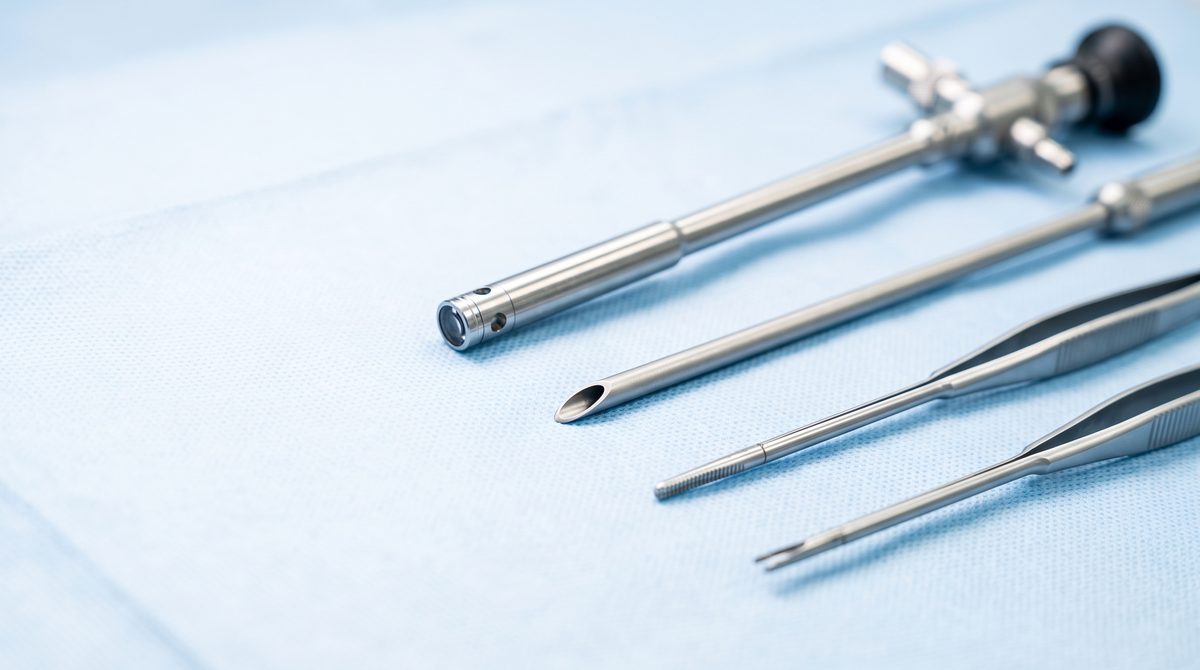
In endoscopic spine surgery, the surgeon works through a thin tube that holds a camera. The tube goes in through an incision that is often about the width of a fingertip. Fine instruments pass through the tube to remove disc material or bone that is pressing on a nerve. Saline flows through the tube to keep the view clear. It is most often used for herniated discs and some kinds of narrowing in the low back. Many patients go home the same day.
Tubular surgery
Tubular surgery uses a series of widening tubes to gently spread the muscle and create a small working space. The surgeon then works through the tube with a microscope. A tubular microdiscectomy or tubular decompression for lumbar stenosis are common examples.
Minimally invasive fusion
Some fusions can also be done with smaller incisions. Screws may be placed through small skin punctures, guided by imaging, rather than through one long incision. Approaches from the side of the body, called lateral fusions, reach the disc space by passing through or beside the muscles of the flank instead of through the back muscles.
Navigated and robotic-assisted surgery
Navigation is not a separate operation but a guidance tool. A 3D scan taken in the operating room gives the surgeon a live map of the spine, and the instruments are tracked on that map in real time. Robotic-assisted systems add an arm that helps hold a planned path steady. These tools may help place screws accurately through small openings. Dr. Higginbotham uses navigated spine surgery, including robotic-arm guidance, as one of those tools. The surgeon still makes every decision and does the surgery.
Possible benefits
For the right patient and the right problem, studies of minimally invasive techniques have found:
- Less blood loss
- Less damage to the back muscles
- Smaller scars
- Shorter hospital stays, and more same-day surgery
- For some people, a quicker return to work and daily life
A 2026 review of 17 randomized trials compared full endoscopic discectomy with standard microscope discectomy for low back disc herniations. Leg pain relief was similar with both. The endoscopic group had less blood loss and, on average, returned to work about three weeks sooner. The endoscopic group also had more X-ray exposure during surgery, since the surgeon depends more on imaging to see.
Limits to understand
Minimally invasive surgery is not the right fit for every spine problem or every patient. Some honest limits:
- Not every condition suits it. Large curves, severe instability, some tumors, infections and revision surgeries may need a larger opening to be done safely and fully.
- Long-term results are often similar. For many conditions, results at one or two years look much the same as open surgery. The main difference tends to be the early recovery.
- It still carries surgical risks. Infection, bleeding, nerve injury, a tear in the lining around the nerves, and the chance that symptoms return are all possible, just as with open surgery.
- Training matters. These techniques take specific training and experience. It is fair to ask a surgeon how often they do the operation they are recommending.
A small incision does not mean a small operation. Removing a disc fragment and fusing two vertebrae are real surgeries, whatever the size of the scar.
Who may be a candidate
People who may be good candidates for minimally invasive surgery often have:
- Leg pain from a herniated disc that has not improved with nonsurgical care, often described as sciatica
- Narrowing at one or two levels causing leg pain with walking
- A slipped vertebra at one level that needs fusion
- Good general health and reasonable bone strength
Your images, your exam and your goals decide which method fits. Sometimes the plan combines minimally invasive steps with a more traditional opening.
What surgery day often looks like
For a smaller procedure such as an endoscopic or tubular discectomy, the day is often shorter than people expect. You check in a few hours before surgery and meet the anesthesia team. Depending on the procedure and your health, you may have general anesthesia or, for some endoscopic cases, sedation with numbing medicine. The operation itself often takes one to two hours. Afterward you rest in recovery, walk with a nurse, and many people head home that afternoon or the next morning with a small bandage. Fusions, even minimally invasive ones, usually mean at least one night in the hospital.
Questions to ask your surgeon
- Could my problem be treated through a smaller opening? If not, why not?
- What exactly will be removed or fixed?
- Will I go home the same day or stay overnight?
- What results and risks should I expect for someone like me?
- If the smaller opening is not enough to finish the job during surgery, what happens then?
When to call us
If you have been told you need back or neck surgery and want to know whether a smaller operation could work for you, call to set up a visit. Bring your MRI and any notes from prior treatment. Dr. Higginbotham can review whether endoscopic, tubular or navigated surgery fits your condition, or whether another plan makes more sense.
Common questions
How long is recovery from endoscopic spine surgery?
Many people walk the same day and go home within hours. Light activity often resumes within one to two weeks, and desk work may follow within a couple of weeks. Heavier work takes longer. Everyone heals at a different pace.
Is minimally invasive spine surgery safer?
It may lower some risks, such as blood loss and wound problems, but it is not risk-free. The safest choice is the one that fits your problem and that your surgeon has solid experience with.
Is laser spine surgery the same thing?
No. "Laser spine surgery" is mostly a marketing term. Lasers play a very small role in spine surgery. Most minimally invasive procedures use tubes, endoscopes and standard surgical tools.
Does robotic surgery mean a robot does the operation?
No. The robotic arm helps guide instruments along a path the surgeon plans. The surgeon controls every step.
Sources
- Minimally Invasive Spine Surgery, AAOS OrthoInfo
- Patel S, et al. Full endoscopic versus microscopic lumbar discectomy for lumbar disc herniation: a meta-analysis of randomized controlled trials. Spine. 2026.
- Robotic surgery, MedlinePlus Medical Encyclopedia (NIH)
- Know Your Back, North American Spine Society