
The short answer
Back pain lives mainly in the back. Sciatica lives mainly in the leg. If your worst pain is in your buttock, thigh, calf or foot, and it feels sharp, burning or electric, a nerve is probably involved. If your pain is centered in the low back, feels achy or stiff, and gets better as you move around, it is more likely coming from the muscles, ligaments or joints.
Many people have some of both. A herniated disc can cause back pain first and leg pain a few days later. Still, the question "which hurts more, the back or the leg?" is one of the most useful ones a spine surgeon asks.
What sciatica is
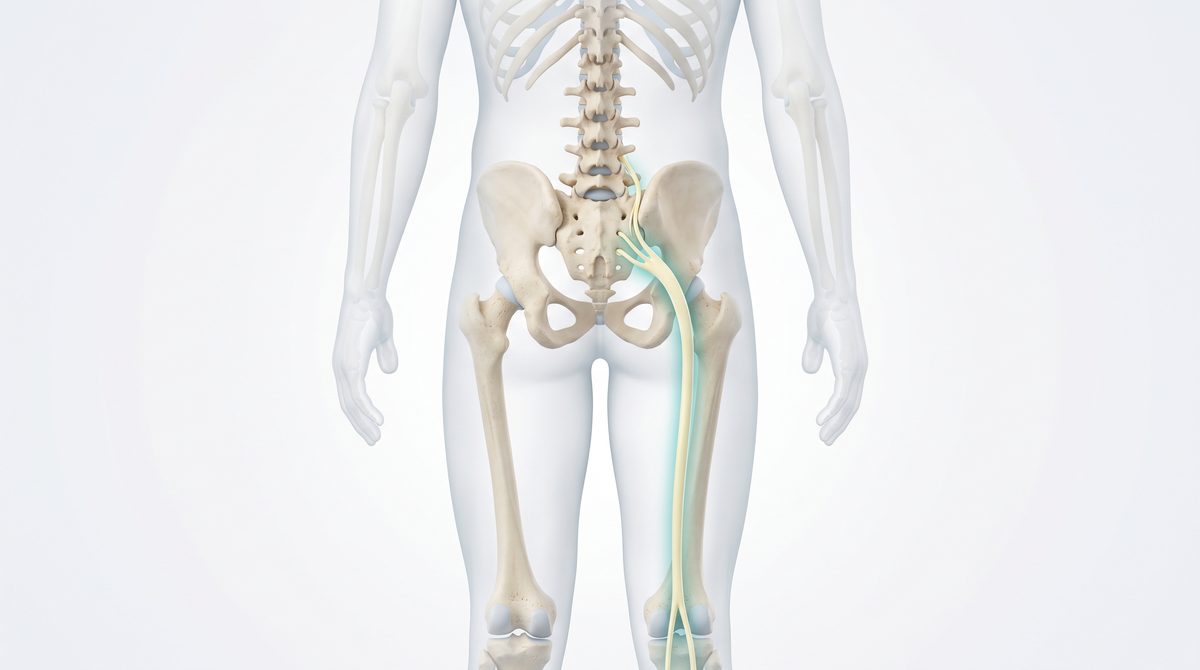
The sciatic nerve is the largest nerve in the body. It forms from nerve roots that leave the lower spine, mostly the L4, L5 and S1 roots, then runs through the buttock and down the back of the leg. When one of those roots is squeezed or inflamed, pain can travel along the nerve's path. Doctors call this lumbar radiculopathy. "Sciatica" is the everyday name.
So sciatica is a symptom, not a diagnosis. The real question is what is pressing on the nerve. The most common causes are:
- A herniated disc, where soft disc material pushes out and irritates a nerve root. This is the usual cause in people under about 50.
- Lumbar spinal stenosis, a narrowing of the canal or the nerve openings from arthritis, thickened ligaments and bulging discs. This is more common after 60.
- Spondylolisthesis, where one vertebra slips forward on the one below and narrows the space for the nerve.
- Less often, a cyst, an infection or a tumor.
Signs that point to sciatica
- Pain that shoots below the knee, often into the calf, ankle or foot
- Burning, electric or "toothache" type pain in the leg
- Numbness or pins and needles in a strip along the leg or foot
- Weakness, such as a foot that slaps or catches when you walk, or trouble rising up on your toes
- Leg pain that gets worse when you cough, sneeze or sit for a long time
- Pain on one side only, in most cases
The location can hint at which nerve is involved. An L5 nerve problem often causes pain across the top of the foot and into the big toe. An S1 problem often goes to the outside of the foot and the sole.
Signs that point to ordinary back pain
- Achy, tight or sore pain across the low back, sometimes into the buttocks or upper thighs
- Pain that does not travel below the knee
- Stiffness in the morning that eases as you warm up
- Muscle spasm after lifting, twisting or a long day of yard or farm work
- No numbness, tingling or weakness in the leg
This kind of pain is sometimes called mechanical or nonspecific back pain. It can come from strained muscles, irritated facet joints or worn discs. It can hurt a lot, but it usually improves within weeks.
What a doctor checks during the exam
A spine exam for leg pain is short but tells a lot. While you lie on your back, the doctor may slowly raise your straight leg. If that brings on your usual leg pain, it points toward an irritated nerve root. The doctor will also test the strength of your hips, knees, ankles and toes, tap your knee and ankle reflexes, and check where the skin feels numb. Each nerve root has its own pattern, so the results help pinpoint the level. Watching you walk on your heels and toes adds more clues. These findings are then compared with the MRI, if one is needed.
What about pain that feels like sciatica but is not?
A few other problems can mimic sciatica. Hip arthritis often causes groin and thigh pain. Irritation of the sacroiliac joint can cause buttock pain that spreads into the thigh. Tight muscles deep in the buttock can also press on the nerve. Poor circulation in the legs can cause calf pain with walking that looks a lot like stenosis. A careful exam helps sort these out, which is one reason an MRI is not the only step.
How each one is usually treated
Both conditions usually start with conservative care: staying as active as you can, short-term medicine, heat or ice, and physical therapy. For many people with back pain alone, that is all they ever need. Our guide to nonsurgical options goes into more detail.
Sciatica from a herniated disc also tends to improve with time. The body often reabsorbs part of the herniated material over weeks to months. An epidural steroid injection may calm the nerve enough to allow therapy.
When leg pain stays severe for six weeks or more, or when there is weakness, surgery may be discussed. Two large trials help frame that choice. In the Dutch sciatica trial, people who had early surgery got relief faster than those who waited, but by one year both groups were doing about the same. In the SPORT trial in the United States, both groups improved, and those who had surgery tended to improve somewhat more. Put simply, surgery often speeds recovery for the right person, while waiting is also a reasonable choice for many.
When surgery is chosen, the usual goal is to remove the piece of disc or bone that is pressing on the nerve. At Central Valley Advanced Spine this may be done with endoscopic spine surgery, which works through a very small opening, or with a microdiscectomy. Surgery for sciatica is aimed at leg pain. It is less reliable for back pain alone.
When to call us
Call if leg pain has not eased after about six weeks of care, if you have numbness that is spreading, or if your foot or leg feels weak. Please go straight to an emergency room for loss of bladder or bowel control, numbness between the legs, or weakness in both legs, since these can signal severe nerve compression.
Common questions
Can sciatica go away on its own?
Yes, often. Many people with sciatica from a herniated disc improve within six to twelve weeks without surgery. The pain can come and go during that time.
Should I rest in bed with sciatica?
Short rest on a bad day is fine, but long bed rest is not advised. Gentle walking and normal activity, within the limits of your pain, usually help more.
Does sciatica always need an MRI?
Not at first. An MRI is usually ordered when symptoms last more than several weeks, when there is weakness, or when an injection or surgery is being planned.
Is sciatica worse when sitting?
For a herniated disc, yes, sitting often makes leg pain worse. For stenosis it is the reverse: sitting and bending forward usually bring relief, and standing or walking bring the pain on.
Sources
- Sciatica, AAOS OrthoInfo
- Sciatica, MedlinePlus (NIH)
- Peul WC, et al. Surgery versus prolonged conservative treatment for sciatica. N Engl J Med. 2007.
- Weinstein JN, et al. Surgical vs nonoperative treatment for lumbar disk herniation: the Spine Patient Outcomes Research Trial (SPORT). JAMA. 2006.